
How Catholic Stories Helped Me Understand My Faith |
A lifelong Catholic who knew all the answers but understood none of them, until the stories brought them to life |
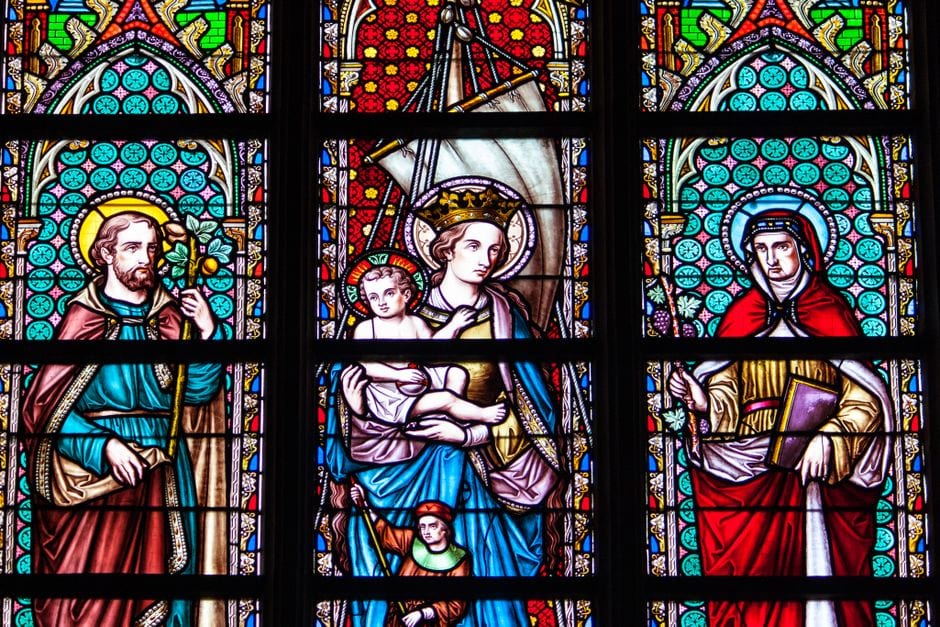
I was born Catholic, baptized Catholic, and raised Catholic.
I went to religious education every Wednesday night from first grade through eighth.
I made my First Communion in a white dress my grandmother sewed by hand.
I was confirmed at sixteen.
If you had given me a quiz on the faith, I would have passed it.
Seven sacraments.
Ten Commandments.
Four Gospels.
I knew all the answers.
I just didn't understand any of them.
The Question in the Dorm Room
My freshman year of college, I roomed with a girl named Kayla.
She grew up in a small Bible church and was curious about everything.
One Sunday, I came back from Mass, and she asked me something I'd never been asked before.
She said, You really believe that bread turns into Jesus?
Not mean.
Just honestly curious.
I said yes.
She asked me why.
And I opened my mouth and nothing came out.
I knew the word transubstantiation.
I could even spell it.
But I couldn't tell her why I believed it, or why it mattered.
That night, I lay awake wondering if I believed anything at all, or if I'd just memorized it.
A Boy Named Tarcisius
A few weeks later, I went home for a weekend and told my grandmother what happened.
She didn't explain the doctrine to me.
She told me a story instead.
She told me about Saint Tarcisius.
He was a boy in ancient Rome, back when being a Christian could get you killed.
The Christians would celebrate Mass in secret, and someone had to carry the Eucharist to prisoners who were waiting to be martyred.
Tarcisius volunteered.
According to the old tradition, a gang of boys stopped him on the road and demanded to see what he was hiding against his chest.
He refused.
They beat him to death, and he never let go.
My grandmother looked at me and said that a boy doesn't die protecting a piece of bread.
He dies protecting a Person.
For the first time, the Eucharist stopped being a vocabulary word.
The Road to Emmaus
That weekend, my grandmother gave me a homework assignment.
Read the last chapter of Luke's Gospel, she said.
Slowly.
So I did, back in my dorm room, while Kayla was at class.
It's the story of two disciples walking to a village called Emmaus on the day of the Resurrection.
They're heartbroken.
They think Jesus is dead and everything is over.
A stranger joins them on the road and explains the Scriptures to them as they walk.
Their hearts burn inside them, but they don't recognize Him.
Then they sit down to eat.
The stranger takes the bread, blesses it, breaks it, and gives it to them.
And in that moment, their eyes are opened.
It's Jesus.
They recognize Him in the breaking of the bread.
I sat on my bed with chills.
Because I realized I had just read the structure of every Mass I had ever been to.
First the Scriptures, explained.
Then the bread, taken, blessed, broken, and given.
Jesus showing up, every Sunday, in exactly the same way.
When Kayla Asked Again
A few days later, Kayla brought it up again.
This time I didn't freeze.
I told her about the road to Emmaus.
I showed her the sixth chapter of John, where Jesus says His flesh is true food, and so many followers walk away that He asks the apostles if they want to leave too.
I told her about Tarcisius.
She didn't become Catholic.
But she said that was the first time the Catholic view had actually made sense to her.
And honestly, it was the first time it really made sense to me too.
Story by Story
After that, I was hooked.
Every part of my faith that felt like a dry fact, I went looking for the story behind it.
I never understood why Catholics love Mary so much.
Then I read about Our Lady of Guadalupe, who appeared to a poor man named Juan Diego in 1531 and spoke to him like a mother, asking him why he was afraid when she was there.
Suddenly Mary wasn't a statue in a church.
She was a mother who comes looking for her children.
I never understood why we pray for people over and over when God already knows what we need.
Then I read about Saint Monica, who prayed and wept for her wayward son for years.
That son became Saint Augustine, one of the greatest minds in the history of the Church.
Persistent prayer stopped being a rule and became a love story.
I never understood confession, not really.
Then I read about Peter, who denied Jesus three times by a charcoal fire the night before the crucifixion.
And how, after the Resurrection, Jesus met him by another charcoal fire and asked him three times, Do you love me?
Three denials.
Three chances to say yes.
That's confession.
Not a punishment.
A do-over, offered by a friend.
Why Stories Work
I've thought a lot about why the stories reached me when the facts didn't.
I think it's because Jesus taught in stories.
The Prodigal Son.
The Good Samaritan.
The Lost Sheep.
He could have just handed out a list of doctrines.
Instead, He told us stories, because stories don't just go into your head.
They go into your heart, and they stay there.
The doctrines are true.
The stories are how I finally believed they were true for me.
Passing It On
I'm twenty-four now.
I teach the confirmation class at my parish on Wednesday nights, in the same building where I used to sit bored out of my mind.
I don't start with the quiz anymore.
I start with a story.
Tarcisius on the road.
Two heartbroken disciples at a dinner table.
A fisherman by a charcoal fire.
I watch the teenagers put their phones down and lean in.
And every year, at least one of them asks me afterward if the story was real.
I tell them it's more real than anything they'll read online that week.
Then I tell them to go home and read the last chapter of Luke.
Slowly.
Anna is a composite character, and this story is illustrative, inspired by the real experiences of many Catholics whose faith came alive through the stories of the Church. |
Your turn: Which Catholic story first made your faith come alive? Tell us in the comments below. |
0 Comments
Join the conversation
Be the first to comment
Share your thoughts above.