
St. Andrew the Apostle: The First Called Who Brought Peter to Jesus |
He was among the first to follow Christ, and his first move was to go get his brother. That fisherman's habit carried him to a cross at Patras. |
Two men stood on the banks of the Jordan River, watching a stranger walk past.
One of them was a fisherman from Galilee.
His teacher, John the Baptist, pointed at the stranger and said, "Behold, the Lamb of God."
The fisherman did not wait.
He turned and followed.
Jesus looked back and asked a simple question.
"What are you looking for?"
The fisherman asked where he was staying.
"Come and see," Jesus said.
So he went, and he stayed the rest of the day.
That fisherman's name was Andrew.
And according to the Gospel of John, he was among the very first people ever to follow Jesus.
The First Called
Eastern Christians have a special title for Andrew.
They call him the Protokletos.
It means "the First Called."
Before Peter, before James and John, Andrew was already walking with Jesus.
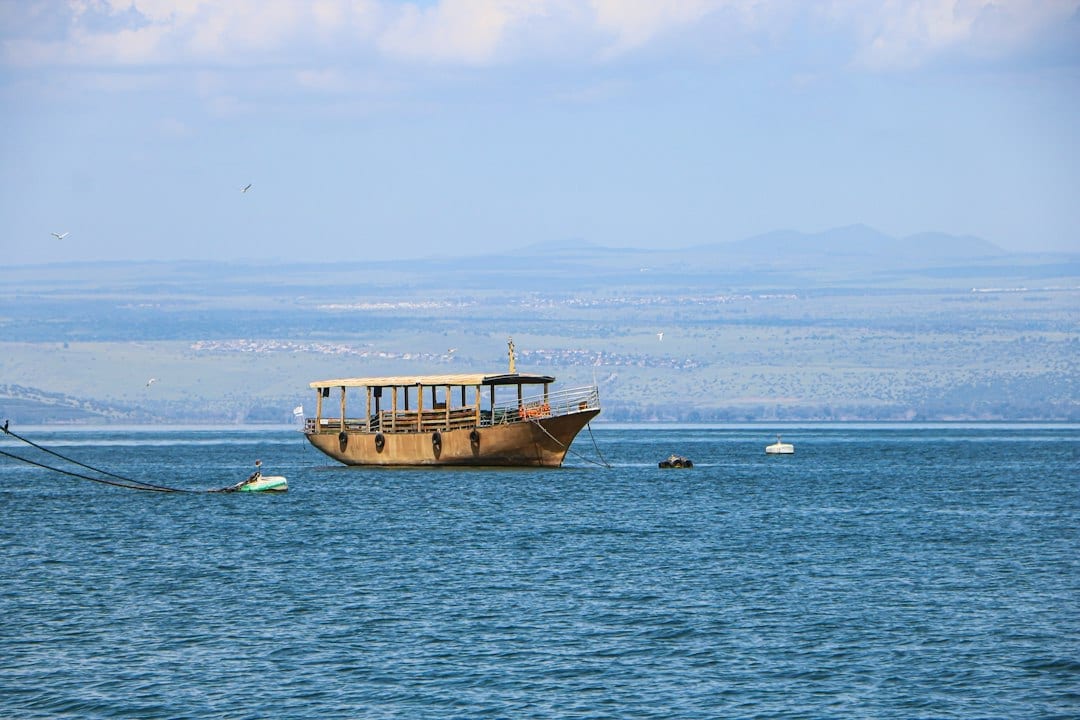
He came from Bethsaida, a fishing town on the Sea of Galilee.
He worked the nets with his brother, Simon.
And here is the first thing Andrew did after meeting Jesus.
He went and found his brother.
"We have found the Messiah," he told him.
Then he brought Simon to Jesus.
Jesus looked at Simon and gave him a new name, Cephas, meaning rock.
We know him as Peter.
Think about that for a moment.
The man who would become the first pope met Jesus because his brother could not keep the news to himself.
Andrew's first act as a disciple was to bring someone else to Christ.
It would become the pattern of his entire life.
The Man Who Kept Bringing People
Andrew is not a loud presence in the Gospels.
But every time John's Gospel shows him, he is doing the same thing.
At the feeding of the five thousand, a huge crowd was hungry and the apostles were at a loss.
Philip said that even two hundred days' wages would not buy enough bread.
Andrew noticed someone everyone else overlooked.
A boy with five barley loaves and two fish.
He brought the boy to Jesus' attention, even while admitting, "What good are these for so many?"
Jesus took that small offering and fed the multitude.
Later, in Jerusalem, some Greeks came looking for Jesus.
They approached Philip.
Philip went to Andrew.
And together, Andrew and Philip brought the request to the Lord.
A brother.
A boy with a lunch.
A group of curious foreigners.
Andrew had an eye for the people others missed, and he kept walking them to Jesus.
Out to the Edges of the World
After Pentecost, the apostles scattered.
The Bible does not tell us where Andrew went.
But early Christian writers did.
The historian Eusebius, writing in the fourth century, passed on a tradition from Origen that Andrew preached in Scythia, the vast region north of the Black Sea.
Other traditions place him in Greece and Asia Minor.
That is why Andrew is honored today as a patron of Romania, Ukraine and Russia, lands whose Christians trace their faith back to his journeys.
These traditions are ancient, but they are traditions, not eyewitness records.
What nearly all of them agree on is where his road ended.
The Cross at Patras
The city was Patras, on the coast of Greece.
According to the ancient account known as the Acts of Andrew, the apostle's preaching angered the Roman governor, and he was sentenced to crucifixion.
Tradition says Andrew was bound to the cross, not nailed, so that his suffering would last longer.
And it says he did not die quickly.
He preached to the crowd from the cross.
The Acts of Andrew is not part of the Bible, and the Church has never treated every detail in it as history.
Over time, another tradition grew up around his death.
It held that Andrew asked to be crucified on a cross shaped like an X, because he did not consider himself worthy to die on the same kind of cross as his Lord.
That X-shaped cross is now known around the world as the St. Andrew's Cross.
Tradition places his martyrdom around the year 60, though no one knows the exact year.
The Church remembers it every year on November 30.
Andrew's story did not end at Patras.
His relics traveled almost as far as he did.
In the fourth century, many of them were moved to Constantinople, the great new capital of the Christian East.
In the 1200s, after crusaders sacked Constantinople, relics of Andrew were brought to the cathedral of Amalfi in southern Italy, where they are still venerated.
In the 1400s, as the Ottoman Turks advanced, the relic of his head was taken to Rome for safekeeping.
It stayed there for five centuries.
Then, in 1964, Pope Paul VI sent it back to Patras as a gesture of friendship toward the Orthodox Church.
The fisherman who once brought his brother to Jesus was now helping to bring divided Christians a little closer together.
How a Galilean Fisherman Ended Up on a Flag
And then there is Scotland.
Andrew never set foot there.
Yet he is Scotland's patron saint, and his cross flies on its national flag.
How?
Medieval legend says a monk named St. Rule, or Regulus, carried some of Andrew's relics to the coast of what is now St. Andrews in Fife.
Another legend tells of a Pictish king named Angus who, before a battle, saw a white X-shaped cross against a blue sky and took it as a sign of Andrew's protection.
Historians cannot confirm either story.
But by the Middle Ages, Andrew was firmly Scotland's saint, and the white saltire on blue became one of the oldest national flags in the world.
Today it is also part of the Union Jack.
There is one more beautiful detail.
Tradition links Peter with the Church of Rome.
And the Church of Constantinople, the great center of Eastern Christianity, honors Andrew as its patron.
Two brothers from a fishing town in Galilee.
Two great Churches of East and West.
Every year on Andrew's feast, the Pope sends a delegation to the Ecumenical Patriarch in Istanbul, and each June the Patriarch sends one to Rome for the feast of Peter.
The brothers are still, in a sense, visiting each other.
The Saint for Everyone Who Brings a Friend
Andrew's feast falls on November 30, right at the threshold of Advent.
Many Catholics mark it by starting the St. Andrew Christmas Novena, a short prayer repeated many times a day until Christmas.
It is fitting.
Andrew's whole life was about pointing toward the coming of Christ.
He never wrote a Gospel.
He never led the Church.
He simply brought people to Jesus, one at a time, and then stepped aside.
Every great story in the Church starts with someone like Andrew, saying, "Come and see."
Somewhere in your life, there may be a Simon waiting for you to say it.
Your turn: Who was the "Andrew" who first brought you closer to Jesus? Share your story in the comments below.
Photo by Kasem Sleem on Unsplash |
0 Comments
Join the conversation
Be the first to comment
Share your thoughts above.