
St. James the Greater: The Son of Thunder Who Became the First Apostle to Die for Christ |
A hot-tempered fisherman promised Jesus he could drink His cup. Fourteen years later, a king's sword proved he meant it. |
The sword came down in Jerusalem around the year 44.
One of the Twelve was dead.
He was the first apostle to give his life for Jesus.
The Bible gives his death exactly one sentence.
Acts 12 says only that King Herod killed James, the brother of John, with the sword.
No speech.
No final prayer recorded.
Just a single line, and then the story moves on.
But that one line marked the end of a remarkable life, and the beginning of a story that would send millions of pilgrims walking across Europe for more than a thousand years.
This is the story of St. James the Greater.
A Fisherman Who Dropped Everything
James grew up working the Sea of Galilee.
His father, Zebedee, ran a fishing business, and the Gospel of Mark notes that the family even had hired men working the boats.
This was not a poor household scraping by.
It was a steady trade, the kind a son could inherit.
James worked it beside his younger brother, John.
Then one day a teacher walked along the shore.
Jesus had just called two other fishermen, Simon and Andrew.
Now he looked at James and John, mending nets in their father's boat, and called them too.
Mark says they left Zebedee in the boat with the hired men and followed him.
Think about that moment for a second.
A father standing in the boat.
Two sons walking away up the beach.
The family business suddenly short two men, all because of one invitation.
James would never go back.
The Sons of Thunder
James was not a quiet man.
Jesus gave him and John a nickname, recorded in Mark's Gospel: Boanerges, meaning "Sons of Thunder."
It fit.
In Luke's Gospel, a Samaritan village refused to welcome Jesus.
James and John had a solution.
They asked if they should call down fire from heaven to destroy the place.
Jesus turned and rebuked them.
On another occasion, their mother came to Jesus with a bold request.
She asked that her two sons sit at his right and left in his kingdom.
Jesus answered the brothers with a question that would follow James for the rest of his life.
Could they drink the cup he was about to drink?
They said they could.
Jesus told them they would.
At the time, James surely did not understand what he had just agreed to.
He would.
The Inner Circle
Here is the surprising part.
This hot-tempered fisherman became one of the three men closest to Jesus.
Peter, James and John were the only apostles allowed into the room when Jesus raised the daughter of Jairus.
They were the only three who climbed the mountain and saw Jesus transfigured in glory, with Moses and Elijah beside him.
And they were the three Jesus brought deeper into the Garden of Gethsemane on the night before he died.
James saw the glory of the Transfiguration.
He also saw his Master's agony in the garden.
And, like the others, he fell asleep while Jesus prayed.
That detail matters.
The Gospels never pretend these men were heroes from the start.
They were ordinary, impulsive, sometimes sleepy men who were slowly being changed.
By the time of Pentecost, the man who once wanted to burn a village was preaching mercy to the very city that had crucified his Lord.
Why is he called "the Greater"?
Not because he was more important.
The title simply separates him from the other apostle named James, called "the Less," and most likely means he was older, or perhaps taller.
The Cup He Promised to Drink
After the Resurrection, James preached in Jerusalem and Judea for more than a decade.
The young Church was growing.
And growth drew attention.
Around the year 44, Herod Agrippa I, grandson of Herod the Great, turned on the Christians.
He had James arrested and executed by the sword.
When Herod saw that it pleased some of the people, he arrested Peter next.
James became the first of the Twelve to be martyred, and the only apostle whose death is recorded in the New Testament.
Years before, he had told Jesus he could drink the cup.
Now he did.
An ancient tradition, preserved by the historian Eusebius from Clement of Alexandria, adds a striking detail.
It says the man who brought James to trial was so moved by his testimony that he declared himself a Christian on the spot and was led away to die beside him.
On the way, the story goes, he asked James to forgive him.
James is said to have paused, wished him peace, and kissed him.
We cannot verify that account the way we can verify Acts.
But it has been treasured for centuries because it sounds exactly like a man transformed.
The Son of Thunder died offering peace.
From Jerusalem to the Field of Stars
Here the story leaves the Bible and enters a long Spanish tradition.
According to that tradition, James had earlier preached in Spain before returning to Jerusalem.
After his death, his disciples are said to have carried his body by sea to the coast of Galicia, in the far northwest of Spain, and buried it inland.
Then, the tradition says, the tomb was forgotten for centuries.
In the early 800s, during the reign of King Alfonso II, a tomb believed to be his was identified, and Bishop Theodemir of Iria declared it the resting place of the apostle.
A church rose over it.
Then a town.
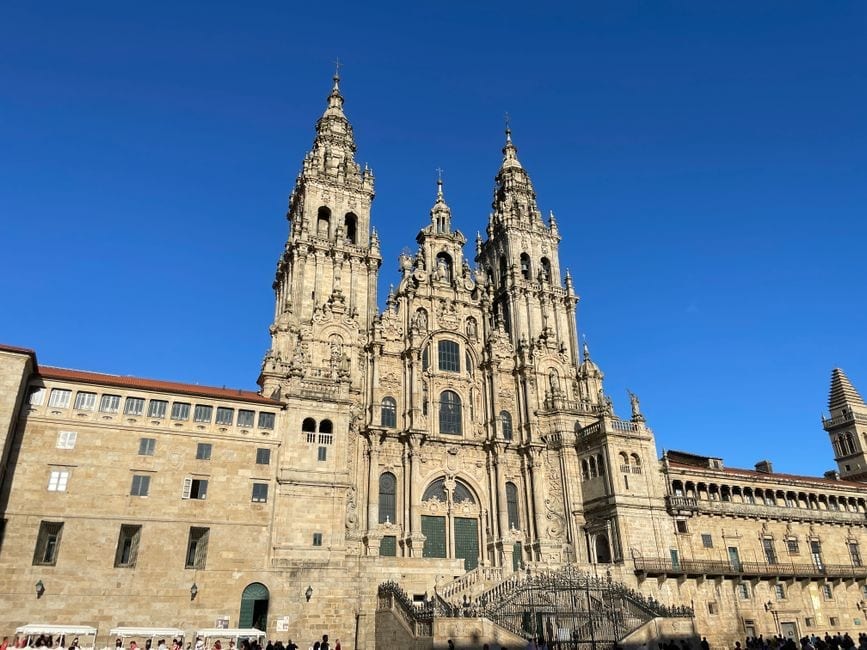
Then one of the great cathedrals of Europe.
The town became Santiago de Compostela, and its name is often linked to the Latin for "field of stars."
Historians openly debate whether James ever reached Spain, and some early writers suggested he never left the Holy Land.
The Church honors the shrine as the place pilgrims have venerated his relics for over a millennium, while the details of how they arrived belong to tradition.
What is not in doubt is what happened next.
Pilgrims came.
From France, Germany, England, Italy and far beyond.
During the Middle Ages, Compostela ranked alongside Jerusalem and Rome as one of the three great pilgrimage destinations of Christendom.
The routes they walked became known as the Camino de Santiago, the Way of St. James.
Pilgrims took the scallop shell as their badge, and it is still tied to backpacks today.
The Pilgrim Apostle for Our Time
Today, hundreds of thousands of people walk the Camino every year.
Some are devout Catholics.
Some are searching.
Some say they are just there for the hike, and are surprised by what happens to them along the way.
Many arrive at the cathedral exhausted, sunburned and in tears.
St. James is honored as the patron saint of Spain and of pilgrims, and the Church celebrates his feast on July 25.
In years when that date falls on a Sunday, Compostela celebrates a special Holy Year.
There is something fitting about all of it.
James spent his life walking.
Away from the boats.
Up the mountain.
Into the garden.
Toward the sword.
He was never a finished saint while he walked.
He was a man with a temper and big ambitions, who was slowly being remade by the One he followed.
That is good news for the rest of us.
You do not have to be gentle to begin following Christ, you only have to keep walking.
Somewhere today, a pilgrim on a dusty road in northern Spain is learning the same lesson James learned two thousand years ago.
The cup is real.
So is the grace to drink it.
Your turn: Have you ever walked a pilgrimage, or faced a "cup" you weren't sure you could drink? Share your story in the comments below.
Photo by Victor Damian on Pexels |
0 Comments
Join the conversation
Be the first to comment
Share your thoughts above.