
The Atheist Who Walked Into a Cathedral and Couldn’t Explain What Happened Next |
On Christmas Day 1886, a skeptical 18-year-old named Paul Claudel stood by a pillar in Notre-Dame, and one song changed his life. |
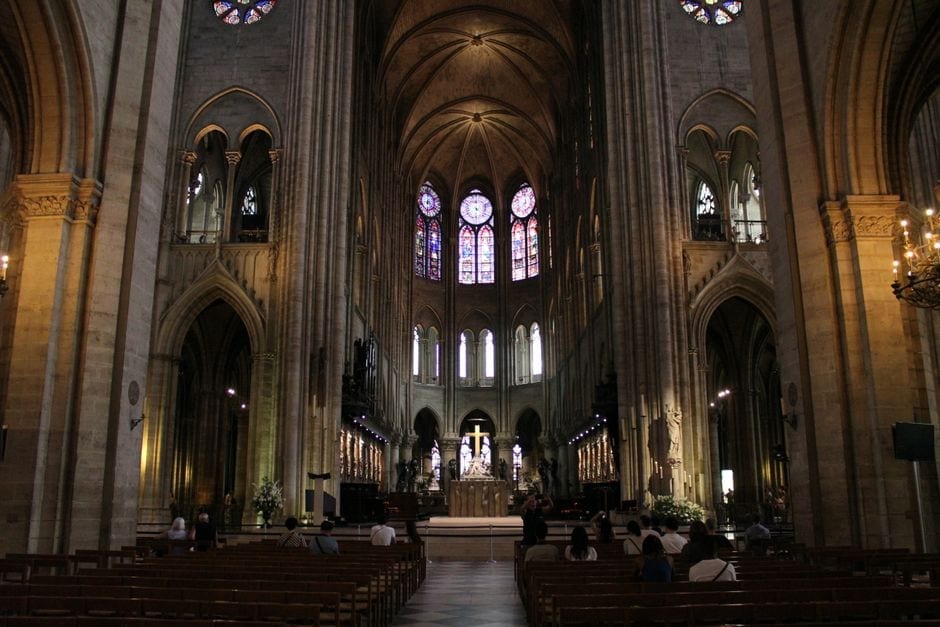
It was Christmas Day, 1886, and Notre-Dame de Paris was packed.
Candles flickered against the old stone.
Incense hung in the cold air.
And standing in the crowd, near a pillar by the entrance to the choir, was an eighteen-year-old who did not believe a word of it.
His name was Paul Claudel.
He had come for the music.
He had come, he would later admit, partly to find material for his writing, perhaps even to look down on it all.
He walked out a different man.
A Young Man Without God
Claudel was born in 1868 in a small village in northern France.
He was baptized as a baby and made his First Communion as a boy.
After that, the faith simply drained out of him.
By his teenage years, he was living in Paris, a brilliant student in a city that prided itself on having outgrown religion.
The intellectual heroes of the day taught that the universe was a machine.
Matter, motion and chance explained everything.
Ernest Renan's famous Life of Jesus had presented Christ as a gentle, admirable man and nothing more.
Only a year before, Paris had given Victor Hugo a vast state funeral and laid him in the Panthéon, a former church turned into a monument to the nation's great men.
The message to a young student was hard to miss.
The future belonged to science and the Republic, not to the altar.
For a young mind like Claudel's, it seemed settled.
God was a story for children and peasants.
But there was a problem.
The machine had no room for meaning.
Claudel later described those years as a time of dark despair, with no moral compass at all.
He was clever, ambitious and quietly miserable.
He had everything the age promised.
Talent, education, a future in the most sophisticated city in Europe.
And underneath it all, an ache he could not name.
The Poet Who Cracked the Door
The first crack came from an unlikely place.
Claudel discovered the poetry of Arthur Rimbaud, the wild young genius whose work seemed to burst out of the narrow world of materialism.
Rimbaud was no saint.
But his words hinted that there was more to reality than what could be weighed and measured.
For Claudel, it was like a window opening in a sealed room.
He did not yet know what was on the other side.
He only knew the air had changed.
Christmas at Notre-Dame
On Christmas Day, 1886, Claudel went to the cathedral for High Mass.
It left him cold.
Then, with nothing better to do, he came back that afternoon for Vespers, the evening prayer of the Church.
He took his place in the crowd, near the second pillar at the entrance to the choir, on the right.
The boys' choir began to sing.
It was the Magnificat, the song of the Virgin Mary from the Gospel of Luke.
My soul magnifies the Lord, and my spirit rejoices in God my Savior.
It is the prayer of a teenage girl from Nazareth who said yes to God when it made no sense.
It is sung in the evening, every evening, by the whole Church across the world.
Claudel had probably heard it before without ever really hearing it.
This time was different.
And something happened that Claudel would spend the rest of his life trying to describe.
In his own memoir, he put it this way:
"Suddenly, in an instant, in a fraction of time, the current of my life was altered and I believed."
There was no argument.
No vision.
No voice from the rafters.
Just a sudden, overwhelming certainty that God was real, that He was present, and that He loved this lonely young man standing by a pillar.
Claudel said the conviction was so strong that nothing afterward could shake it.
Not books.
Not arguments.
Not the sneers of his friends.
The Long Walk Home
Here is the part of the story people often skip.
Claudel did not walk out of Notre-Dame and straight into the confessional.
He went home that night stunned.
He took up a Protestant Bible his sister had been given and began reading the Gospels.
He read Pascal, Bossuet and Dante.
He went back to Notre-Dame again and again.
But his mind was still full of the old objections, and his habits were still the habits of a young man of Paris.
For four years, his heart believed while the rest of him fought.
He was afraid of what his family and friends would say.
He was afraid of what the Church would ask of him.
He was afraid, perhaps most of all, of what an honest confession would demand.
Finally, he surrendered.
On Christmas Day, 1890, exactly four years after that afternoon at Vespers, Paul Claudel received Holy Communion again at Notre-Dame.
He had come all the way home.
The young man who once thought faith was for peasants now knelt among them.
A Life on Fire
What came next was extraordinary.
Claudel became a diplomat, serving France across the world, including long years as a consul in China.
He became one of the greatest poets and playwrights France has ever produced.
His plays, rich with grace, sin, longing and sacrifice, are still performed today.
His life was not tidy.
As a young diplomat, he fell into a painful affair that pulled him away from the faith for a time.
He came back.
He married, raised a large family and spent his final decades writing about Scripture.
He died in 1955.
Today, a small plaque near the spot where he stood marks the day: 25 December 1886, the conversion of Paul Claudel, and one word.
Magnificat.
In 2019, the world watched in horror as fire tore through the roof of Notre-Dame and sent its spire crashing down.
Many feared the cathedral was lost.
It was not.
After five years of painstaking work, it reopened in December 2024, and the evening prayer of the Church rose once more under its vaults.
The same song that broke open Claudel's heart is still sung there.
Why It Still Happens
It would be easy to read Claudel's story and think it belongs to another age.
But every year, people walk into churches they do not believe in.
They come for a wedding, a funeral, a concert, a tour.
They come because a friend asked, or because the music is beautiful, or because they are lonely and cannot say why.
And sometimes, standing at the back, something happens they cannot explain.
Claudel's story is a reminder that God does not always win us with arguments.
Sometimes He wins us with a song.
Sometimes He meets us right where we are standing, arms crossed, sure that we are only there to watch.
And if it is happening to you, take heart from the rest of Claudel's story too.
Faith that arrives in an instant can take years to unpack.
That is not failure.
That is the road home.
Your turn: Has a hymn, a Mass or a moment in a church ever moved you in a way you couldn't explain? Share your story in the comments below.
Photo by alex ohan on Pexels |
0 Comments
Join the conversation
Be the first to comment
Share your thoughts above.