
The Catholic Miracle Scientists Still Study Centuries Later |
In 1970, the Church let a pathologist break the seals on Lanciano's ancient relics. What he reported is still debated today. |
Lanciano, Italy, November 1970.
In a quiet church on the Adriatic side of the country, a group of Church officials gathers around an ornate reliquary.
Inside it are relics that the people of this town have venerated for centuries.
A thin, brownish membrane said to be flesh.
Five small, hardened clots said to be blood.
For the first time in living memory, the seals are about to be broken.
And the man doing it is not a priest.
He is a scientist.
The Story Behind the Relics
According to tradition, sometime in the eighth century a monk celebrating Mass in Lanciano was struggling with a secret doubt.
He wondered whether the bread and wine on the altar truly became the Body and Blood of Christ.
As he spoke the words of consecration, the story says, the Host became living flesh and the wine became blood.
Regular readers will remember we told that monk's story before.
This time, we want to ask a different question.
What happens when you put a miracle under a microscope?
First, an honest note about history.
There are no surviving documents from the eighth century describing the event.
The earliest written account that clearly mentions a Eucharistic miracle kept in Lanciano dates to 1574, when the local archbishop, Gaspare Rodriguez, examined the relics.
Everything before that rests on local tradition, which is exactly why a scientific look mattered so much.
The Professor From Arezzo
In 1970, the Franciscan friars who care for the shrine, with the approval of the archbishop and authorization from Rome, asked for a medical examination.
The job went to Professor Odoardo Linoli, head of the laboratory of clinical analysis and pathological anatomy at the hospital in Arezzo.
He was also a professor of anatomy, histology, chemistry and clinical microscopy.
Linoli removed small fragments of the relics and took them back to his lab.
To check his conclusions about the tissue, he consulted Professor Ruggero Bertelli, an anatomist at the University of Siena.
On March 4, 1971, Linoli presented his results in Lanciano, and he later published them in an Italian medical journal, Quaderni Sclavo di Diagnostica.
What He Said He Found
Linoli's report made five main claims.
First, the flesh was real flesh, and specifically heart muscle tissue.
He reported seeing the inner lining of the heart, along with blood vessels and nerve fibers.
Second, the blood was real blood.
Third, both the flesh and the blood were human.
Fourth, both belonged to the same blood type: AB.
Fifth, the proteins in the blood were present in proportions similar to those of normal fresh blood.
He also reported that he found no traces of preservatives.
Linoli later told the Catholic news agency ZENIT that he had no doubt he was looking at cardiac tissue.
He also pointed out that blood type AB is quite rare among people in that part of Italy, but considerably more common in the Middle East.
For many Catholics, the findings were breathtaking.
A doubting monk had asked whether the Host was really flesh, and a modern pathologist reported finding heart.
Where the Story Gets Overstated
Here is where honesty matters, because Lanciano is often told with more confidence than the evidence allows.
Many popular articles claim that a World Health Organization commission later confirmed Linoli's work in 1973.
We could not find any documentation of such a WHO study, and researchers who have looked into the claim have found none either.
It is best not to repeat it.
You will also find a tradition that the five blood clots each weigh the same as all five together.
That is a pious story connected to the 1574 examination, not a scientific finding.
Skeptics raise fair questions too.
The key analysis was carried out more than fifty years ago, largely by one lead investigator, with the techniques available at the time.
Some researchers have questioned parts of the findings, and others have argued that a fresh, independent study using modern methods would settle a great deal.
None of that proves the relics are fake.
But it does mean no honest person should call Lanciano a scientific proof of anything.
What the Church Actually Claims
This surprises many people.
The Catholic Church does not require anyone to believe in the miracle of Lanciano.
The relics have been honored with the Church's permission for centuries, and pilgrims are welcome to pray before them.
But Eucharistic miracles are not part of the deposit of faith.
Catholic belief in the Real Presence of Christ does not rest on a laboratory report.
It rests on the words of Jesus at the Last Supper, on His teaching in the sixth chapter of John's Gospel, and on the faith the Church has held since its earliest days.
In fact, at every ordinary Mass, the Eucharist still looks, tastes and feels like bread and wine.
The Church teaches that Christ is truly present precisely where nothing visible changes.
Seen that way, Lanciano is not the foundation of the faith.
It is a sign pointing to what happens quietly on every altar in the world.
Why People Still Come
Today the relics are displayed in the Church of San Francesco in Lanciano.
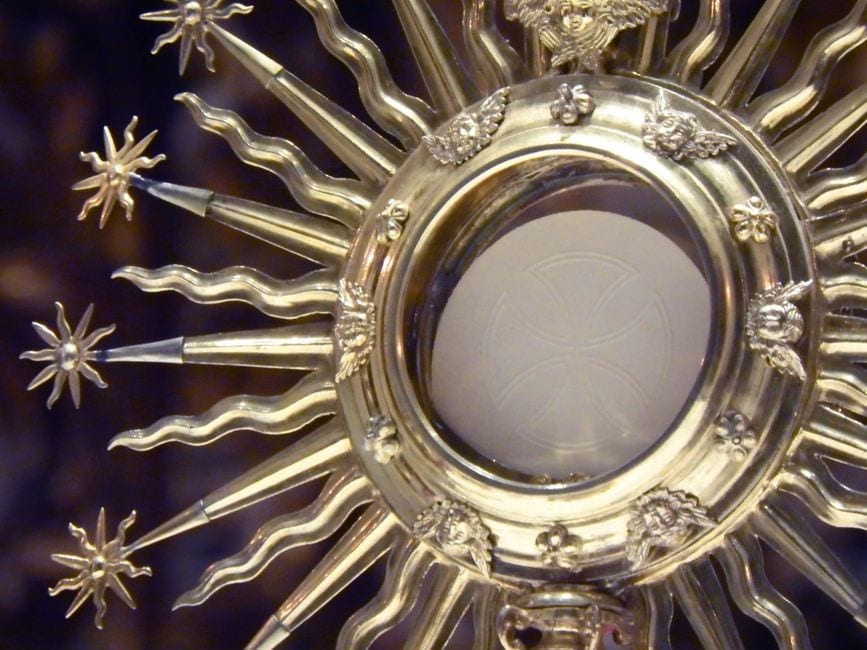
The flesh is held in a silver monstrance, and the blood rests in a crystal chalice below it.
Pilgrims arrive from around the world, some full of faith, some full of questions.
Many of them, like that monk long ago, come carrying a private doubt they have never said out loud.
Science can describe tissue, measure proteins and type blood.
It cannot tell a person whether to kneel.
That question, in Lanciano and in every parish church, is still answered the same way it always has been: by faith.
Your turn: Has a Eucharistic miracle, or a quiet moment at Mass, ever helped you through a season of doubt? Share your story in the comments below.
Photo by David Eucaristía on Pexels |
0 Comments
Join the conversation
Be the first to comment
Share your thoughts above.