
The Emperor Who Saw a Cross in the Sky Before Battle |
Outnumbered and far from home, Constantine marched on Rome beneath a strange new sign, and the age of the martyrs came to an end. |
The sun was sinking over the hills north of Rome.
An army sat camped in the autumn dust, tired, outnumbered and far from home.
Its general, Constantine, had marched all the way from Gaul to fight for the most powerful city on earth.
And somewhere in the sky that day, according to the story he would tell for the rest of his life, he saw something that changed history.
A cross of light.
Above the sun.
A Gamble for the Throne of Rome
In the year 312, the Roman Empire was not one empire at all.
It was a broken table of rival emperors, each claiming a piece of the world.
Constantine ruled in the west, in Gaul and Britain.
His rival, Maxentius, held Rome itself, behind its great walls and with a larger army.
For Christians, these were frightening years.
Only a decade earlier, the Great Persecution under Diocletian had burned churches, seized Scriptures and sent believers to their deaths.
Nobody expected the next emperor to change that.
Constantine himself had grown up honoring the Unconquered Sun.
But as he marched toward Rome, he knew one thing for certain.
He needed help from heaven.
Earlier rulers who had tried to take Rome from Maxentius had failed.
One had been betrayed by his own troops.
Another had retreated in humiliation.
Constantine was walking into the same trap, deeper into Italy, further from his supply lines, with every mile.
If he lost, there would be no second chance.
The Sign in the Sky
Two Christian writers who lived through these years tell us what happened next.
Their accounts are not identical, and that matters.
Lactantius, a teacher who tutored Constantine's son, wrote within a few years of the battle.
He says Constantine was told in a dream to mark the heavenly sign of God on his soldiers' shields before the fight.
The sign was a monogram of Christ, formed from the first Greek letters of His name.
The emperor obeyed.
Eusebius of Caesarea, the great historian of the early Church, tells a more dramatic version in his Life of Constantine, written years later.
Eusebius said he heard it from the emperor himself.
According to this account, Constantine and his whole army saw a cross of light in the sky, above the sun, with Greek words beside it.
"In this, conquer."
Later generations would know the phrase in Latin: In hoc signo vinces.
That night, Eusebius writes, Christ appeared to Constantine in a dream and told him to make a copy of the sign and carry it into battle.
So the emperor called his craftsmen.
They built a tall standard covered in gold, crowned with the Chi-Rho, the monogram of Christ.
It became known as the labarum.
The Battle at the Milvian Bridge
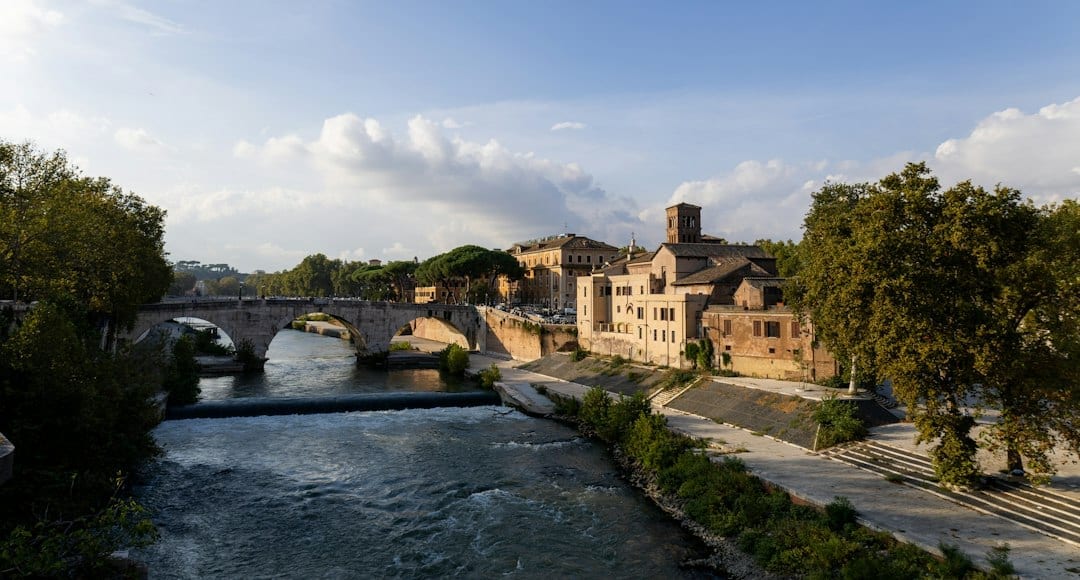
On October 28, 312, the two armies met near the Milvian Bridge, an old stone crossing over the Tiber River just north of Rome.
Maxentius could have stayed safely behind the city's walls.
Instead, he marched out to fight.
He had the river at his back.
It was a fatal mistake.
Constantine's cavalry smashed into the enemy lines.
The army of Maxentius broke and fled toward the river.
Men crowded onto the narrow crossings, pushing and falling.
In the chaos, Maxentius himself was thrown into the Tiber.
He drowned in the water he had hoped would protect him.
His body was later pulled from the river.
By nightfall, it was over.
The next day, Constantine entered Rome as its master.
From Persecuted to Protected
What came next is one of the most stunning reversals in history.
In 313, Constantine and his fellow emperor Licinius agreed to the policy we now call the Edict of Milan.
It granted freedom of worship across the empire, and Christians could finally gather openly.
Confiscated churches and property were ordered returned.
Think about that.
A generation earlier, Christians were being hunted.
Now the emperor of Rome was funding the building of churches.
Under Constantine's patronage, great basilicas began to rise, including the original St. Peter's over the tomb of the Apostle on the Vatican Hill.
In 325, he summoned the bishops of the world to Nicaea, where the Church proclaimed the faith we still pray in the Nicene Creed.
And yet Constantine's own journey was slow and complicated.
He was a soldier and a politician, capable of real ruthlessness.
He kept titles and symbols of the old Roman religion for years.
He was baptized only near the end of his life, in 337.
His mother, Helena, took a different road.
She embraced the faith with her whole heart and, in old age, made a pilgrimage to the Holy Land.
Ancient tradition credits her with finding the wood of the True Cross in Jerusalem, and the Church honors her as a saint.
It is a fitting twist.
The son carried the sign of the Cross into battle.
The mother went looking for the Cross itself.
What Really Happened in the Sky?
Historians have argued about that day for centuries.
Some think Constantine saw a natural solar halo, a ring or cross of light that can appear around the sun.
Others believe the story grew in the retelling, or that it was shaped to serve the emperor's image.
Some modern scholars doubt that any vision occurred at all.
The Church has never defined what exactly Constantine saw.
It is not a matter of dogma.
But the honest Christian answer does not have to be anxious.
Our two closest sources agree on the heart of the story: before the battle, Constantine believed the God of the Christians had shown him a sign, and he put that sign on his army.
What he did next is not in doubt.
Coins, monuments and laws from his reign show the Christian symbol moving steadily to the center of Roman public life.
On a silver medallion struck only a few years after the battle, Constantine is shown with the Chi-Rho on his helmet.
The man who rode beneath the Chi-Rho ended the age of the martyrs.
Why This Story Still Matters
It is easy to think of the Cross as a symbol of defeat.
For the Romans, it was exactly that.
It was the death they reserved for slaves and rebels, the most shameful end imaginable.
Christ turned it into the sign of victory over sin and death.
And at the Milvian Bridge, that same sign was carried at the head of a Roman army.
That does not mean God takes sides in every war.
The deeper lesson is quieter, and it reaches every one of us.
We all have battles we cannot win alone.
A diagnosis, a broken marriage, an addiction, a fear that will not leave us at night.
The Church still invites us to do what Constantine did, in a far humbler way.
Trace the sign of the Cross.
Put it on the front lines of your life.
Make it the first thing you do when you wake and the last thing you do before sleep.
Make it before the hard conversation, the medical test, the job interview, the long drive.
It takes two seconds.
It has been carried by emperors and by children, by martyrs in the arena and by grandmothers at the kitchen sink.
In this sign, conquer.
Your turn: When has the sign of the Cross given you courage before a hard battle in your own life? Share your story in the comments below.
Photo by Mick Kirchman on Unsplash |
0 Comments
Join the conversation
Be the first to comment
Share your thoughts above.