The Night Christianity Went From Illegal to Imperial |
A sign in the sky, a river battle outside Rome, and the emperor who ended three centuries of persecution |
The night of October 27, in the year 312, was cold along the Tiber.
Thousands of soldiers lay camped a few miles north of Rome, staring toward a city they had marched hundreds of miles to take.
Their general, Constantine, was outnumbered.
He was far from home.
And by every human calculation, he was about to gamble his life and his empire on a single morning.
What happened in the hours before that battle would change the fate of a hunted religion forever.
A Faith Soaked in Blood
To understand why that night mattered, you have to remember what being Christian meant just a few years earlier.
In 303, Emperor Diocletian launched what history calls the Great Persecution.
Churches were torn down.
Sacred Scriptures were hunted and thrown into bonfires.
Bishops, priests and ordinary believers were arrested, tortured and executed for refusing to offer sacrifice to the Roman gods.
For nearly three centuries, following Christ could cost you everything.
Christians had worshiped in homes, in hidden rooms and near the tombs of their martyrs.
They had buried their dead in the catacombs and prayed for the very emperors who killed them.
By 312, the worst of the violence had eased in parts of the empire, but the Church still lived at the mercy of whoever held power.
And power was up for grabs.
Two Men, One Throne
The Roman Empire had splintered into rival claimants.
Constantine ruled in the west from Gaul and Britain.
His rival, Maxentius, held Italy and the city of Rome itself.
Constantine crossed the Alps and fought his way south, city by city.
Maxentius waited behind Rome's massive walls with a larger army and every advantage.
Then, for reasons historians still debate, Maxentius marched out to meet him.
The two armies would clash near the Milvian Bridge, a stone crossing over the Tiber on the northern edge of the city.
The Sign
Here is where the story turns.
Two Christian writers of the age tell us what happened, and their accounts differ in the details.
Lactantius, a teacher who knew the imperial court, wrote within a few years of the battle.
He says Constantine was told in a dream to mark the heavenly sign of God on his soldiers' shields before the fight.
That sign was the Chi-Rho, the first two Greek letters of the name of Christ, laid one over the other.
Eusebius of Caesarea, a bishop and historian, wrote decades later, after Constantine's death.
He claimed the emperor himself had told him the story and sworn to its truth.
According to Eusebius, Constantine and his troops saw a cross of light above the sun, with words telling him that in this sign he would conquer.
That night, Eusebius says, Christ appeared to Constantine in a dream and told him to make the sign his standard in battle.
Was it a vision, a dream, or both?
Historians have argued about it for seventeen centuries.
But on one point the sources agree.
Constantine went into battle under the name of Christ.
The Bridge Collapses
On October 28, the armies met.
Maxentius had arranged his troops with the river at their backs.
It was a terrible decision.
Constantine's cavalry smashed into his lines and drove them toward the water.
The retreating soldiers crowded onto a temporary bridge of boats that had been thrown across the Tiber.
Under the weight of the panicked army, it gave way.
Men in armor plunged into the river.
Maxentius was among them.
His body was pulled from the Tiber, and the next day Constantine rode into Rome as its undisputed master.
A persecuted minority suddenly had a friend on the throne.
From Hiding to Open Daylight
The change came fast.
In early 313, Constantine met his fellow emperor Licinius in Milan.
Together they agreed on a policy that became known as the Edict of Milan.
It granted freedom of worship to Christians and to everyone else in the empire.
It ordered that churches, cemeteries and property seized during the persecutions be returned.
Imagine being an old Christian in Rome that year.
You might have watched your friends die in the arena.
You might have hidden your family's copy of the Gospels under the floorboards.
Now the emperor himself was funding new churches.
Within a few years, construction began on the great basilica of St. John Lateran, and later a basilica rose over the tomb of St. Peter on the Vatican Hill.
In 325, Constantine gathered bishops from across the empire at Nicaea, where they defined the faith in words Catholics still pray in the Creed today.
A Complicated Convert
It would be easy to tell this as a tidy fairy tale.
It was not.
Constantine was a hard and sometimes ruthless man.
He kept titles and symbols from the old Roman religion for years.
His own family suffered from his violence.
And he put off baptism until he lay dying in 337, a custom some believers of his time followed.
Christianity did not become the official religion of the empire under Constantine either.
That came decades later, in 380, under Emperor Theodosius.
Still, the turn was real.
Before the Milvian Bridge, the Church was a community that could be outlawed at any moment.
After it, the Church stood in the open, building, teaching and worshiping in full view of the world.
The Blessing and the Danger
The Church gained enormous freedom on that October day.
It also gained a new kind of temptation.
When faith becomes fashionable, comfort can creep in where courage used to live.
Within a generation, some Christians fled to the deserts of Egypt to pray and fast, partly because the faith had grown so comfortable in the cities.
The age of the martyrs gave way to the age of the monks.
Both, in their own way, were trying to keep Christ at the center.
Why It Still Matters
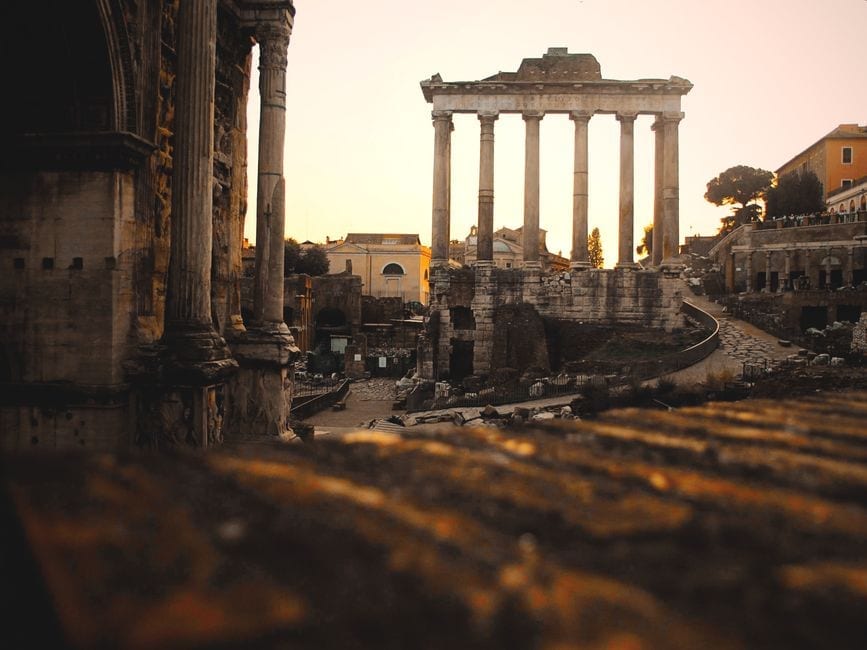
Walk through Rome today and you can still stand near the Milvian Bridge.
You can still pass under the Arch of Constantine beside the Colosseum, built to honor his victory.
And you can still kneel in basilicas whose foundations were laid in the years right after that battle.
The story reminds us that God can work through the most unlikely people and the most chaotic moments of history.
A soldier facing death looked up and chose to trust a sign.
Whatever exactly he saw, the world was never the same.
Your turn: Do you think the Church was stronger when it was persecuted or when it was free? Share your thoughts in the comments below.
Photo by Horia Horobeanu on Pexels |
0 Comments
Join the conversation
Be the first to comment
Share your thoughts above.